
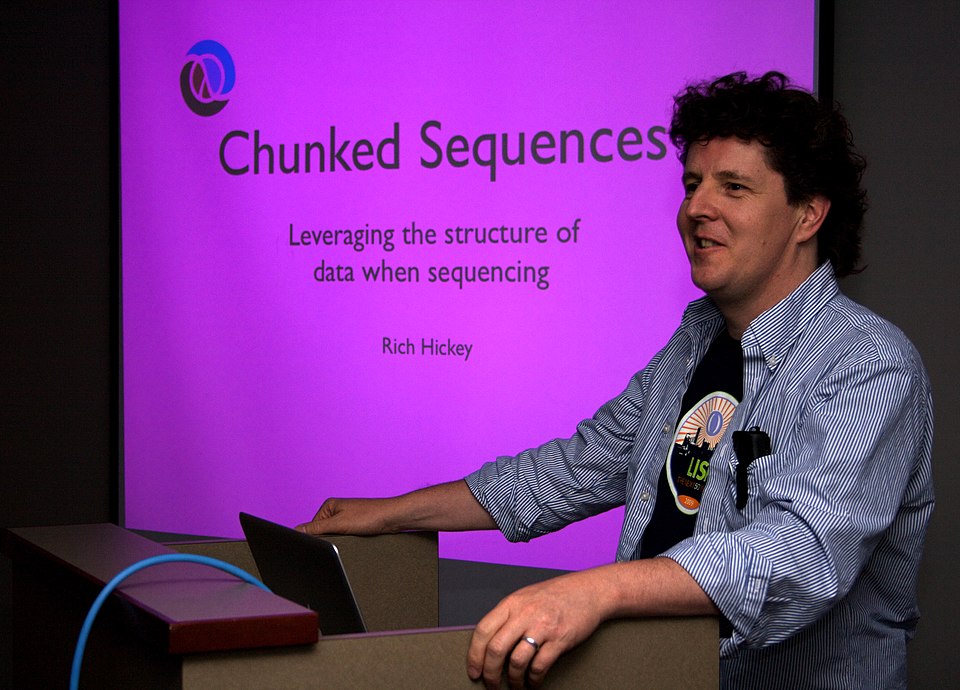
Rich Hickey doesn't do keynotes at every conference. He doesn't have a YouTube course empire or a bestselling book series. He gave a handful of talks, built two transformative pieces of software, and changed how thousands of developers think about their craft. That's a different kind of influence — quieter, deeper, and harder to shake off once it lands.
Before Clojure
Hickey spent over twenty years as a consultant and developer, working primarily in C++ and Java. He built scheduling systems, broadcast automation software, and audio analysis tools — real-world, production systems with hard constraints.
During that time, he grew increasingly frustrated with the accidental complexity baked into mainstream object-oriented programming. Mutable state everywhere. Complex inheritance hierarchies that modeled nothing real. Concurrency treated as an afterthought, patched over with locks and synchronized blocks. He didn't write a blog post about it. He spent two years designing a language.
Clojure: a Lisp for the real world
Released in 2007, Clojure was Rich Hickey's answer to a question most people weren't asking: what if we took immutability seriously?
Clojure runs on the JVM, giving it access to the entire Java ecosystem — a pragmatic choice that set it apart from academic functional languages. But the design decisions are what matter:
- Immutable data structures by default. Values don't change. If you want a new version, you create one. This eliminates entire categories of bugs related to shared mutable state.
- Persistent data structures. Clojure's vectors, maps, and sets share structure under the hood, making immutability efficient — not a performance tax.
- Code as data. As a Lisp, Clojure treats code as data structures (homoiconicity), enabling macros that transform programs as naturally as functions transform values.
- Concurrency primitives built in. Atoms, refs, agents, and the STM (Software Transactional Memory) provide coordinated state management without manual locking.
- A strong opinion on state. Hickey drew a hard line between identity (a stable reference over time) and state (the value an identity holds at a point in time). This distinction, laid out in his talk Are We There Yet?, is one of the most important conceptual contributions to modern programming.
Clojure didn't try to be everything. It didn't have classes, didn't have type annotations (initially), didn't try to look like Java. It traded familiarity for coherence — and attracted developers who were tired of fighting their tools.
The talks that changed minds
Hickey's real superpower is his ability to take a concept everyone thinks they understand and show them they don't. His talks are dense, precise, and rewatchable:
- Simple Made Easy (2011) — The distinction between simple (not interleaved) and easy (familiar). The most important 36 minutes in software engineering education.
- Are We There Yet? (2009) — A deep examination of time, identity, and state. Why mutable objects are a broken model of reality.
- The Value of Values (2012) — Why values (immutable facts) are superior to places (mutable references) as the foundation of information systems.
- Hammock Driven Development (2010) — A case for thinking before coding. Step away from the keyboard. Let the subconscious work. The best debugger is a hammock.
- The Language of the System (2012) — Why the properties of a good system (queues, immutability, loose coupling) should be reflected in the programming language itself.
- Spec-ulation (2016) — A sharp critique of semantic versioning and breaking changes. If you break your consumers, you didn't version — you created a new thing.
Each talk starts from first principles. Hickey doesn't say "here's a pattern." He says "here's how we think about this problem — and here's why that thinking is wrong." Then he proposes an alternative that, once heard, is hard to unsee.
Datomic: rethinking the database
In 2012, Hickey and his team released Datomic, a database built on the same principles as Clojure:
- Immutable facts. The database stores facts over time. Nothing is ever updated or deleted — new facts are asserted, old facts remain. The entire history of your data is always available.
- Separation of reads and writes. Queries don't compete with transactions. Reads happen against an immutable snapshot.
- Datalog query language. Instead of SQL, Datomic uses a logic-based query language that composes naturally and avoids the impedance mismatch between code and queries.
Datomic never became mainstream, but its ideas seeped into the industry. Event sourcing, append-only logs, temporal databases — the conversation shifted partly because Hickey built a working system that proved these ideas weren't just academic.
The philosophy underneath
What sets Hickey apart from most language designers is that he starts from philosophy, not syntax. His influences — Alfred North Whitehead's process philosophy, the information theory distinction between information and mechanism — aren't typical programming references.
His core thesis is deceptively simple: most software complexity is accidental, not essential. We complicate things not because the problem demands it, but because our tools and habits push us toward interleaving concerns. Mutable objects encourage coupling. Inheritance encourages taxonomy where there is none. ORMs encourage pretending databases are object stores.
The antidote, in Hickey's view, is always the same: go back to data. Data is simple. Data is transparent. Data doesn't hide behind methods. Data composes. If your architecture is built on plain data — maps, vectors, sets — it's easier to inspect, test, serialize, and reason about than any class hierarchy.
There's also a deeply artisanal dimension to Hickey's work that you rarely find in other language creators. For him, coding isn't assembling bricks — it's designing living systems. A program isn't a frozen artifact you ship and forget: it's an organism that evolves, that accumulates facts over time, that must remain comprehensible as it grows. That's why immutability isn't a technical choice for Hickey — it's a design ethic. Every decision in Clojure and Datomic reflects this obsession with building systems that age well: that stay malleable without becoming brittle, that welcome change without losing their integrity. Like a cabinetmaker who studies the grain before making a cut, Hickey spends more time thinking about the problem than writing code — and it shows in every seam of his creations.
Why he matters
Rich Hickey matters because he proved that simplicity is not a compromise. You don't have to give up power to gain clarity. You don't have to give up performance to gain immutability. You don't have to give up practicality to gain elegance.
He also proved something less technical but equally important: you don't have to be loud to be influential. No Twitter storms, no flame wars, no hot takes. Just a language, a database, and a handful of talks — each one saying: think harder, complect less, and trust the data.
That's enough. It's more than enough.